“Among these unalienable rights, as proclaimed in that great document, is the right of men to pursue their happiness, by which is meant the right to pursue any lawful business or vocation, in any manner not inconsistent with the equal rights of others, which may increase their prosperity or develop their faculties, so as to give
to them their highest enjoyment. The common business and callings of life, the ordinary trades and pursuits, which are innocuous in themselves, and have been followed in all communities from time immemorial, must therefore be free in this country to all alike upon the same conditions. The right to pursue them, without let or hinderance, except that which is applied to all persons of the same age, sex, and condition, is a distinguishing privilege of citizens of the United States, and an essential element of that freedom which they claim as their birthright. It has been well said that ‘THE PROPERTY WHICH EVERY MAN HAS IN HIS OWN LABOR, AS IT IS THE ORIGINAL FOUNDATION OF ALL OTHER PROPERTY, SO IT IS THE MOST SACRED AND INVIOLABLE. The patrimony of the poor man lies in the strength and dexterity of his own hands, and to hinder his employing this strength and dexterity in what manner he thinks proper, without injury to his neighbor, is a plain violation of this most sacred property. It is a manifest encroachment upon the just liberty both of the workman and of those who might be disposed to employ him. . . The right to follow any of the common occupations of life is an inalienable right, it was formulated as such under the phrase ‘pursuit of happiness’ in the Declaration of Independence, which commenced with the fundamental proposition that ‘all men are created equal; that they are endowed by their Creator with certain inalienable rights; that among these are life, liberty, and the pursuit of happiness.’ This right is a large ingredient in the civil liberty of the citizen. To deny it to all but a few favored individuals, by investing the latter with a monopoly, is to invade one of the
fundamental privileges of the citizen, contrary not only to common right, but, as I think, to the express words of the constitution. It is what no legislature has a right to do; and no contract to that end can be binding on subsequent legislatures. . .” Butchers’ Union Co. V. Crescent City Co., 111 U.S. 746 (1884)”
“From these passages it is evident; that the right of acquiring and possessing property, and having it protected, is one of the natural, inherent, and unalienable rights of man. Men have a sense of property: Property is necessary to their subsistence, and correspondent to their natural wants and desires; its security was one of the objects, that induced them to unite in society. No man would become a member of a community, in which he could not enjoy the fruits of his honest labour and industry. . . The constitution expressly declares, that the right of acquiring,
possessing, and protecting property is natural, inherent, and unalienable. It is a right not ex gratia from the legislature, but ex debito from the constitution. . .Where is the security, where the inviolability of property, if the legislature, by aprivate act, affecting particular persons ONLY, can take land from one citizen, who acquired it legally, and vest it in another?” Vanhorne’s Lessee v. Dorrance, 2 U.S.
304 (1795)
“John Locke reasoned that God gave the earth and everything in it to the whole human family as a gift. Therefore the land, the sea, the acorns in the forest, the deer feeding in the meadow belong to everyone “in common.” However, the moment someone takes the trouble to change something from its original state of nature, that person has added his ingenuity or labor to make that change. Herein lies the secret to the origin of “property rights.””
Related Library Documents:
Amazon Affiliate Products
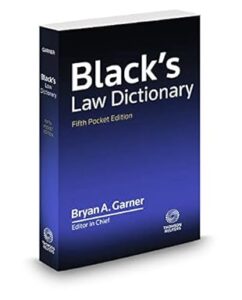
Black’s Law Dictionary
Black’s Law Dictionary, Pocket Edition is the top-selling paperback law dictionary for good reason. With more than 19,000 definitions from the industry-standard Black’s Law Dictionary 10th, it is an essential reference tool for legal terms in a compact format.
View Product
The Constitution of the United States of America
This book is a public collection of the four original documents in the founding of the United States of America and include, the Declaration of Independence, the Articles of Confederation, the Constitutions, and the Bill of Rights. Combined these documents are excellent primary historical sources for the American Revolution and the formation of the new republican state.
View Product